EXECUTIVE SUMMARY
Innovation creates possibility. Execution turns it into lasting value.
Ideas become innovations only when they are implemented, adopted and translated into meaningful outcomes. Project, programme and portfolio management provide the connective discipline that carries a vision through strategic choices, coordinated execution and benefits realisation.
THE LINE OF SIGHT
From belief to benefits
Innovation Is More Than the Generation of Ideas
Innovation is often associated with creativity, technological breakthroughs or the introduction of new products. Yet generating ideas is only one part of the journey. The real challenge lies in translating those ideas into practical solutions that create meaningful and sustainable value.
An idea becomes an innovation when it is implemented and delivers value to its intended users, customers, organisations or society. That value may appear as improved productivity, better customer experiences, economic growth, environmental sustainability or social advancement.
Innovation can be incremental, involving continuous improvements to existing products and processes, or radical, fundamentally changing how an industry operates. It may emerge from scientific discoveries, new business models, redesigned processes, organisational changes or entirely new ways of addressing established problems.
Technological breakthroughs
Electricity, the internet and biotechnology have fundamentally changed industries and how people live and work.
Economic growth
Digital platforms and the sharing economy have created markets, reshaped expectations and challenged traditional structures.
Environmental sustainability
Renewable energy, storage, material science and circular production systems address resource and environmental constraints.
Social advancement
Innovation in education, public services and access to information can improve inclusion and expand opportunity.
Across these diverse applications, one thread remains constant: innovation requires more than an isolated breakthrough. It requires the ability to connect intent with implementation and implementation with outcomes.
The Japanese perspective on innovation—particularly its relationship with technological advancement and socioeconomic reform—provides a useful lens. Technology can be a powerful catalyst, but its broader impact depends on how effectively it is translated into new capabilities, operating models and outcomes.
“How can organisations systematically convert innovative intent into realised value?
One answer lies in the synthesis of innovation management and project and programme management.
Why Innovation Needs Project Management
Innovation frequently begins with uncertainty. The desired outcome may be clear, but the path is not. New materials must be tested, technologies validated, customer needs understood, capabilities developed and commercial assumptions challenged.
Without a structured approach, promising innovations can become fragmented experiments. Teams may pursue competing priorities, resources may be spread too thinly, dependencies may remain unresolved, and projects may deliver outputs that do not contribute to strategic objectives.
Project management provides a disciplined mechanism for converting objectives into actionable plans. It helps define scope, allocate resources, manage schedules, assess risks, establish responsibilities and track progress. Innovation, however, often extends beyond the boundaries of any individual project.
Developing a sustainable product may require simultaneous advances in material science, manufacturing processes, supplier capabilities, product design, quality assurance, regulatory compliance and market development. Each workstream can have its own objective, but the business outcome depends on their successful integration.
Deliver the output
Creates a defined product, service, capability or change.
Coordinate the outcome
Integrates related projects and activities to realise broader benefits.
Choose the investments
Directs resources toward the initiatives that best serve strategic priorities.
Together, these disciplines provide a structured pathway from innovation intent to value creation.
From Strategy to Execution: Understanding the P2M Perspective
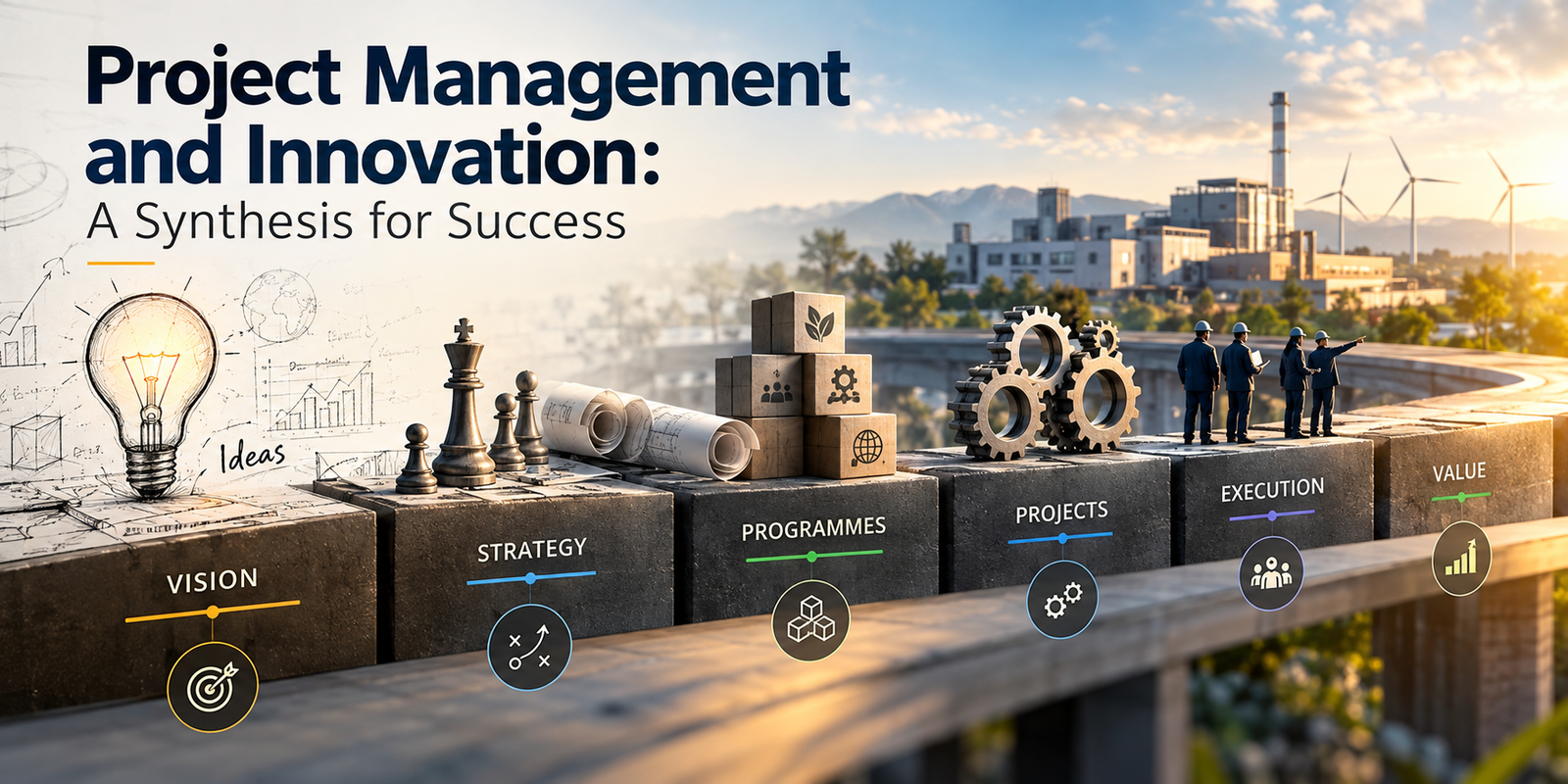
The P2M perspective connects strategic intent with mission-oriented programmes and individual projects. Rather than treating projects as independent activities, it asks how a strategic mission can be translated into coordinated programmes and executable initiatives.
The purpose is not administrative complexity. It is to preserve a clear line of sight between the original vision and operational activity.
- Belief and vision: What future do we want to create?
- Strategic intent: What fundamental change are we committed to achieving?
- Strategy: What choices and capabilities will help us achieve it?
- Programmes: What coordinated initiatives will translate strategy into reality?
- Projects: What specific deliverables must be developed or implemented?
- Work packages and tasks: What activities, owners, resources and milestones are required?
- Outcomes and value realisation: What has changed, and what measurable value has been created?
An Illustrative Case: P2M Innovation in an Electronics Manufacturing Company
Imagine an electronics manufacturing company founded by Hiroto, an entrepreneur who believes that industrial growth and environmental responsibility need not be competing objectives. His ambition is to build a company recognised for high-quality electronics, responsible resource use and a low environmental impact.
Belief and Vision
Hiroto’s vision is to create a leading producer of sustainable electronics. It provides direction and inspiration, but does not yet define the investments, technologies, operating changes or capabilities required. A vision without an execution pathway risks remaining an aspiration.
Strategic Intent and Strategy
The intent is to embed sustainability across the product lifecycle—from material selection and design to manufacturing, sourcing and end-of-life management.
- Invest in research and development for lower-impact materials.
- Improve energy and resource efficiency in manufacturing.
- Develop suppliers that meet sustainability and quality requirements.
- Strengthen employee capability in sustainable production.
- Design products for durability, repairability and recyclability.
- Set measurable environmental and commercial performance targets.
Strategic intent establishes direction; strategy identifies the choices and capabilities through which that direction will be pursued. Measures such as energy per unit, material yield, manufacturing cost, reliability, recycled content and lifecycle impact turn aspiration into an operational priority.
Mission-Oriented Programmes
The strategy becomes three coordinated programmes. Each requires specialised expertise; their collective value depends on how effectively they work together.
Green Material Research and Product Innovation
Identify and validate materials that reduce environmental impact without compromising safety, reliability or performance.
- Research lower-impact polymers and alternatives to conventional plastics.
- Evaluate recycled metals for electronic components.
- Test alternative soldering materials and production methods.
- Assess lifecycle, cost, durability and regulatory implications.
Sustainable Manufacturing Transformation
Reduce the environmental footprint of manufacturing while strengthening process stability and operating performance.
- Conduct energy and resource-efficiency assessments.
- Evaluate renewable energy options and monitoring systems.
- Reduce material waste, scrap and rework.
- Improve planning, utilisation, stability and employee capability.
Sustainable Supply Chain Development
Build upstream supplier capability, traceability and resilience to support responsible production at scale.
- Evaluate sustainable-material suppliers.
- Develop qualification, audit and traceability processes.
- Collaborate on material quality and process improvement.
- Monitor supply, lead-time, cost and sustainability risk.
Projects, Work Packages and Tasks
Each programme is divided into projects with clear deliverables, responsibilities, resources, milestones and acceptance criteria. A project to evaluate a lower-impact polymer for an electronic enclosure might contain five work packages.
Requirements and Feasibility
- Define functional and performance requirements.
- Review candidate materials and technical evidence.
- Assess cost, availability and environmental considerations.
- Identify safety, regulatory and quality requirements.
Laboratory Testing
- Obtain representative samples.
- Conduct mechanical, thermal and dimensional tests.
- Evaluate durability and manufacturing compatibility.
- Compare performance with the existing material.
Prototype and Manufacturing Validation
- Develop prototype components.
- Test the intended manufacturing process.
- Assess cycle time, defects, yield and process stability.
- Verify assembly and downstream compatibility.
Commercial and Lifecycle Assessment
- Compare material and conversion costs.
- Assess supplier capacity and sourcing risk.
- Estimate lifecycle impact using appropriate evidence.
- Evaluate customer acceptance and market needs.
Industrialisation and Scale-Up
- Finalise specifications and quality controls.
- Qualify the supplier and production process.
- Train relevant employees.
- Establish monitoring and post-implementation reviews.
Each package can be divided further into tasks with owners, timelines, budgets, dependencies and completion criteria. But the company must resist measuring success solely through task completion. Laboratory tests or supplier approval represent progress; neither proves that the innovation will create value in commercial production.
Integration: The Difference Between Delivering Projects and Delivering Innovation
The real challenge begins when individual projects must work together. Suppose a research team identifies a promising polymer, laboratory tests confirm its specifications and the supplier can produce it at scale. The manufacturing team then discovers that it requires different processing conditions, increases cycle time, creates dimensional variation and affects downstream assembly reliability.
The material may be technically promising, but the business case is uncertain. This is why innovation cannot be managed as a collection of independent projects. The company must understand the interaction between materials, equipment, process parameters, quality, supplier performance, employee skills and commercial objectives.
Dependency management
Identify where one project’s deliverables affect another.
Cross-functional decisions
Bring R&D, engineering, procurement, operations, quality, finance and commercial teams together.
Risk management
Assess technical, operational, financial, supply-chain and market uncertainty.
Stage-gate decisions
Require evidence before committing to expensive development or scale-up.
Change management
Prepare employees, suppliers and operating teams to adopt the solution.
Benefits tracking
Measure whether expected improvements materialise after implementation.
“Integration is not a common project plan. It is the management of relationships between decisions, capabilities, activities and outcomes.
Innovation Requires More Than Technology
A new material, advanced machine, digital monitoring system or energy-efficient process can provide significant potential. Its benefits, however, depend on how effectively the organisation incorporates it into its operating environment.
- People and capability: Employees need the knowledge and skills to operate, maintain and improve the new systems.
- Process readiness: Existing processes may need redesign or stabilisation before technology can deliver its potential.
- Leadership and governance: Leaders must set priorities, resolve conflicts, allocate resources and decide in time.
- Supplier and ecosystem readiness: Partners need the technical, operational and commercial capability to support implementation.
- Change management: Employees must understand why the change matters, how work changes and what support exists.
- Commercial viability: The innovation must satisfy customers within an economically sustainable model.
These conditions are interdependent. A technically successful innovation may fail to scale if the workforce is unprepared, the process unstable, the supplier base unreliable or customers unwilling to pay for the resulting value. Organisational readiness and adoption must therefore be managed alongside technical development.
Measuring Success: From Project Outputs to Business Outcomes
A project can meet its schedule, budget and technical specifications without achieving the broader objectives that justified the investment. For Hiroto’s company, success should be evaluated at three connected levels.
Project performance
Schedule, cost, quality, technical feasibility and accepted deliverables.
Programme outcomes
Adoption, integration, operating capability and sustained process change.
Strategic benefits
Environmental improvement, commercial value, resilience and customer impact.
All measures must be interpreted together. Lower energy use per unit may indicate efficiency, but total energy, production volume, quality and the impacts of additional materials or processes still matter. Recycled material may reduce virgin-resource dependence while increasing cost or quality risk. The decision requires balance rather than optimisation of one indicator.
A CRITICAL DISTINCTION
Output → Outcome → Benefit
An output is what the project delivers. An outcome is the change enabled by that output. A benefit is the measurable value created by the change.
A validated material specification is an output. Successful use of that material in production is an outcome. Reduced lifecycle impact or stronger cost competitiveness is the benefit. Delivering an output is necessary; realising the intended benefits is the ultimate objective.
From Individual Successes to Organisational Capability
Once the first projects are complete, Hiroto faces another challenge: making success repeatable and scalable. If every innovation depends on a small group of specialists, knowledge remains fragmented, successful practices may not spread and lessons can be lost.
A mature approach builds organisational capability alongside individual innovations. It creates standard methods for evaluating opportunities, documenting lessons, managing technical knowledge, developing skills, sharing proven practices and monitoring benefits after implementation.
It also learns from unsuccessful experiments. Not every hypothesis will prove correct. The objective is to manage uncertainty intelligently, identify weak assumptions early and redirect resources when evidence shows that a proposed solution will not deliver value.
“Over time, project management becomes more than a delivery discipline. It becomes part of the organisation’s learning and innovation system.
The organisation develops the ability to identify opportunities, test ideas, coordinate complex initiatives, scale successful solutions and continually improve performance.
A Practical Framework for Synthesising Project Management and Innovation
Organisations seeking to strengthen the connection between innovation and execution can follow eight practical steps.
Define the mission
Clarify the challenge, desired outcomes and stakeholders who should benefit.
Translate intent into strategic choices
Identify the technologies, capabilities, investments, partnerships and operating-model changes required.
Structure the programmes
Group related initiatives around strategic objectives, with clear ownership and governance.
Select and design projects
Define deliverables, scope, resources, milestones, dependencies, risks and acceptance criteria.
Integrate execution
Coordinate cross-functional teams and use evidence-based reviews to guide decisions.
Prepare for adoption and scale
Build workforce capability, operating processes, supplier readiness and change support.
Measure outcomes and benefits
Track performance beyond closure and compare realised value with the business case.
Institutionalise learning
Capture lessons, replicate proven solutions and strengthen future innovation capability.
This framework provides structure without assuming that every innovation follows a predictable path. Exploration may require experimentation and iteration, while industrialisation and deployment require more formal controls. Governance should reflect uncertainty, complexity, risk and scale.
Conclusion: Innovation Is a Journey from Intent to Impact
Innovation is often celebrated at the moment of discovery—the breakthrough idea, new technology or product launch. Yet lasting value is determined by what happens before and after that moment.
Ideas must be translated into strategy. Strategy must become coordinated programmes. Programmes must deliver integrated projects. Projects must produce solutions that people can adopt and organisations can scale. Those solutions must then generate measurable benefits.
The P2M perspective connects the ambition of a mission with the discipline of execution while recognising that the objective is broader than completing individual projects. For Hiroto’s company, success is not simply a new material, solar panels or a qualified supplier. It is the integration of those initiatives into a commercially viable manufacturing system that improves environmental, operational and customer outcomes.
The lesson extends beyond electronics manufacturing. Whether the task is a new product, digital manufacturing, supply-chain transformation, public-service improvement or a new business model, innovation requires both imagination and execution.
FROM INTENT TO IMPACT
Innovation creates the possibility of change. Project and programme management turn that possibility into reality.
Strategic alignment, organisational integration and benefits realisation determine whether that reality creates lasting value.
REFERENCES
- P2M – Project and Program Management for Enterprise Innovation
- OECD – Oslo Manual 2018: Innovation
- PMI – The Standard for Program Management
- ISO 21502 – Project Management Guidelines
- PMI – Benefits Realization Management
Disclaimer: The views and opinions expressed in this article are personal and do not necessarily reflect those of any organisations associated with the author.