

EXECUTIVE SUMMARY
The GCC is evolving from a delivery centre into an enterprise intelligence system.
Operational scale remains valuable, but it is no longer enough. Mature Global Capability Centres create advantage by sensing change early, interpreting patterns, learning continuously and influencing enterprise decisions before disruption fully materializes.
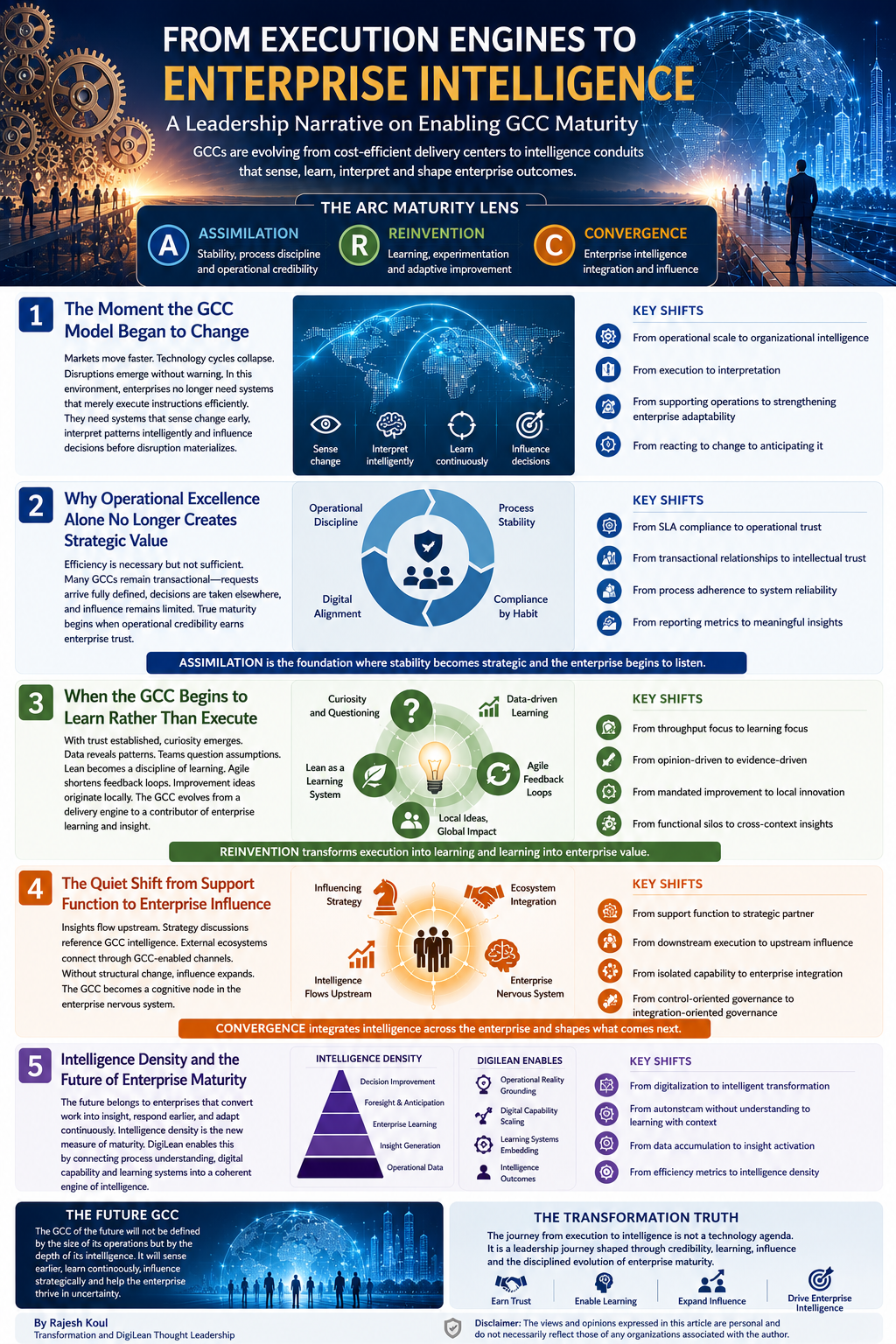
THE ARC MATURITY LENS
Three shifts that change the role of a GCC
Assimilation
Stability, process discipline and operational credibility.
Reinvention
Learning, experimentation and adaptive improvement.
Convergence
Enterprise intelligence, integration and influence.
The Moment the GCC Model Began to Change
For decades, Global Capability Centres were designed around a relatively stable enterprise assumption: scale creates advantage. Organizations built GCCs to standardize operations, reduce cost structures, centralize talent and improve process efficiency across global operations. Success was measured through predictability. The more seamlessly work could move across geographies, functions and systems, the more valuable the GCC became to the enterprise.
In many ways, this model delivered extraordinary value during an era where operational excellence and labour arbitrage defined competitiveness. Yet the environment surrounding enterprises today no longer behaves with the same predictability that shaped the original GCC construct. Markets shift faster, technology cycles collapse rapidly, disruptions emerge without warning and interconnected risks move across supply chains, customers, operations and ecosystems in real time.
In such an environment, enterprises are no longer searching only for operational scale. They are searching for organizational intelligence.
“Enterprises no longer require centres that merely execute instructions efficiently. They require systems capable of sensing, interpreting, learning and influencing.
This subtle shift is reshaping the future role of GCCs more profoundly than most organizations realize. The enterprise increasingly expects GCCs not only to support operations, but to strengthen enterprise adaptability.
In the earlier paper, GCCs Reimagined: From Extended Enterprise to Intelligence Conduits, the ARC maturity lens — Assimilation, Reinvention and Convergence — was introduced as a way to understand this transformation journey. But maturity rarely unfolds through frameworks alone. It emerges through leadership behaviour, operational trust, learning capability and the gradual expansion of enterprise influence.
Why Operational Excellence Alone No Longer Creates Strategic Value
Every GCC transformation journey begins from a place that appears successful on the surface. Delivery metrics remain stable, service levels are achieved consistently, governance mechanisms operate efficiently and processes appear disciplined. Yet operational stability alone does not automatically create strategic influence.
A GCC may be highly efficient and still remain fundamentally transactional in its relationship with the enterprise. Requests continue to arrive fully defined, escalation structures remain centralized and strategic decisions are made elsewhere. The GCC executes exceptionally well, but it does not meaningfully shape enterprise thinking.
Organizations often respond by attempting to leap directly into innovation programs, advanced analytics initiatives or large-scale digital transformation agendas. Mature GCC leaders recognize a deeper truth: influence cannot be declared through organizational ambition alone. It must be earned through operational credibility, trust and consistency over time.
It is the point where operational behaviour becomes stable, predictable and intelligently governed — and where the enterprise starts trusting the GCC’s judgement.
In mature assimilation environments, processes no longer remain stable because teams are continuously reacting to issues. They remain stable because the system itself has evolved toward reliability. Variability is understood scientifically rather than explained away operationally. Compliance no longer dominates leadership conversations because discipline has become habitual. Digital systems begin reflecting operational reality rather than functioning as disconnected reporting overlays.
Something strategically important begins to happen. Enterprise stakeholders stop asking whether the process is being followed correctly and begin asking what the GCC is observing, learning and sensing across the system. That change in dialogue marks the beginning of intellectual trust.
When the GCC Begins to Learn Rather Than Execute
Once operational trust becomes established, the nature of work inside the GCC begins to evolve in unexpected ways. Teams that were once focused almost entirely on execution gradually begin identifying inefficiencies beyond their immediate operational boundaries. Data starts revealing patterns across functions, regions, customer interactions and enterprise processes that challenge long-standing assumptions.
Questions begin emerging naturally from the system itself. Why do similar operational failures repeat across different geographies? Why do process bottlenecks continue despite increasing automation investments? Why does decision-making remain reactive even when large volumes of operational data exist?
This is the point where Reinvention quietly begins. When the organization is genuinely ready, Reinvention rarely feels disruptive. It feels like clarity emerging from operational noise. Problems once silently tolerated become discussable. Teams challenge legacy assumptions because evidence begins replacing hierarchy-driven opinion.
“Lean stops behaving merely as a discipline of operational control and becomes a mechanism for reflection, experimentation and adaptive improvement.
The emotional character of work also changes. Improvement ideas increasingly originate locally rather than arriving exclusively through centralized mandates. Teams begin explaining why something changed rather than simply reporting what changed. Learning starts flowing across organizational boundaries.
Agile practices gain relevance not because they are fashionable rituals, but because shorter feedback loops become essential for enterprise adaptability. Over time, the GCC begins to feel less like a delivery engine and more like an active contributor to enterprise evolution.
The Quiet Shift from Support Function to Enterprise Influence
There comes a stage in GCC maturity where transformation becomes visible not through organizational announcements, but through the changing nature of enterprise influence. Strategic discussions begin referencing operational insights generated within the GCC ecosystem. Planning assumptions are increasingly shaped by signals emerging from operational data.
External ecosystems involving startups, technology partners, universities and innovation networks begin interacting with the enterprise through GCC-enabled intelligence flows. Without dramatic restructuring, the GCC gradually starts influencing how the enterprise interprets its environment.
This is the essence of Convergence. It is not primarily a governance or organizational redesign exercise. It is the gradual integration of sensing, interpretation, learning and decision-making across the enterprise system. Intelligence begins flowing upstream as naturally as operational work once flowed downstream.
Leadership priorities evolve substantially during this stage. The challenge is no longer merely building capability. It becomes sustaining coherence across technology investments, talent ecosystems, operational governance, external partnerships and enterprise strategy.
At this level of maturity, the GCC no longer waits for work to arrive fully defined. It increasingly participates in defining what the enterprise should focus on next. The most mature GCCs begin behaving less like operational centres and more like enterprise synapses — continuously connecting sensing, interpretation, learning and coordinated response.
Intelligence Density and the Future of Enterprise Maturity
One of the most important shifts occurring across modern enterprises is the movement away from purely efficiency-driven maturity models toward intelligence-driven maturity models. Traditional metrics such as utilization, SLA adherence, productivity and cost optimization still matter, but they no longer fully explain enterprise readiness in a volatile environment.
A NEW MEASURE OF MATURITY
Intelligence density
The extent to which operational activity contributes to insight, foresight, learning and enterprise-level decision improvement.
Highly mature organizations do not merely process work faster. They interpret reality earlier. They identify weak signals before disruption fully materializes, shorten learning cycles across the enterprise ecosystem and improve decision quality through continuous sensing and adaptation.
This is where many digital transformations reveal their limitations. Organizations often deploy automation, analytics platforms, dashboards and AI systems while failing to improve organizational learning itself. Speed increases, but interpretation quality remains weak. Data volumes grow, yet decision-making remains reactive. Automation without process understanding frequently accelerates inefficiency rather than eliminating it.
This is precisely where DigiLean becomes increasingly important. DigiLean is not simply about digitizing Lean practices or automating operational workflows. Its deeper significance lies in integrating process understanding, operational stability, learning systems and digital capability into a coherent enterprise framework.
“The future GCC will be defined by how effectively it strengthens the enterprise’s ability to sense, learn, adapt and anticipate change.
By grounding digital transformation within operational reality while enabling enterprise-level learning, DigiLean allows intelligence to scale without destabilizing the organization itself. It creates the conditions where operational excellence and enterprise intelligence evolve together rather than independently.
In that future state, the GCC will no longer function simply as an extended enterprise capability. It will become part of the enterprise’s thinking apparatus itself — continuously shaping how the organization understands the world around it and how intelligently it responds to what comes next.
THE TRANSFORMATION TRUTH
The journey from execution to intelligence is not a technology agenda.
It is a leadership journey shaped through credibility, learning, influence and the disciplined evolution of enterprise maturity.
Disclaimer: The views and opinions expressed in this article are personal and do not necessarily reflect those of any organizations associated with the author.