LEAN THINKING
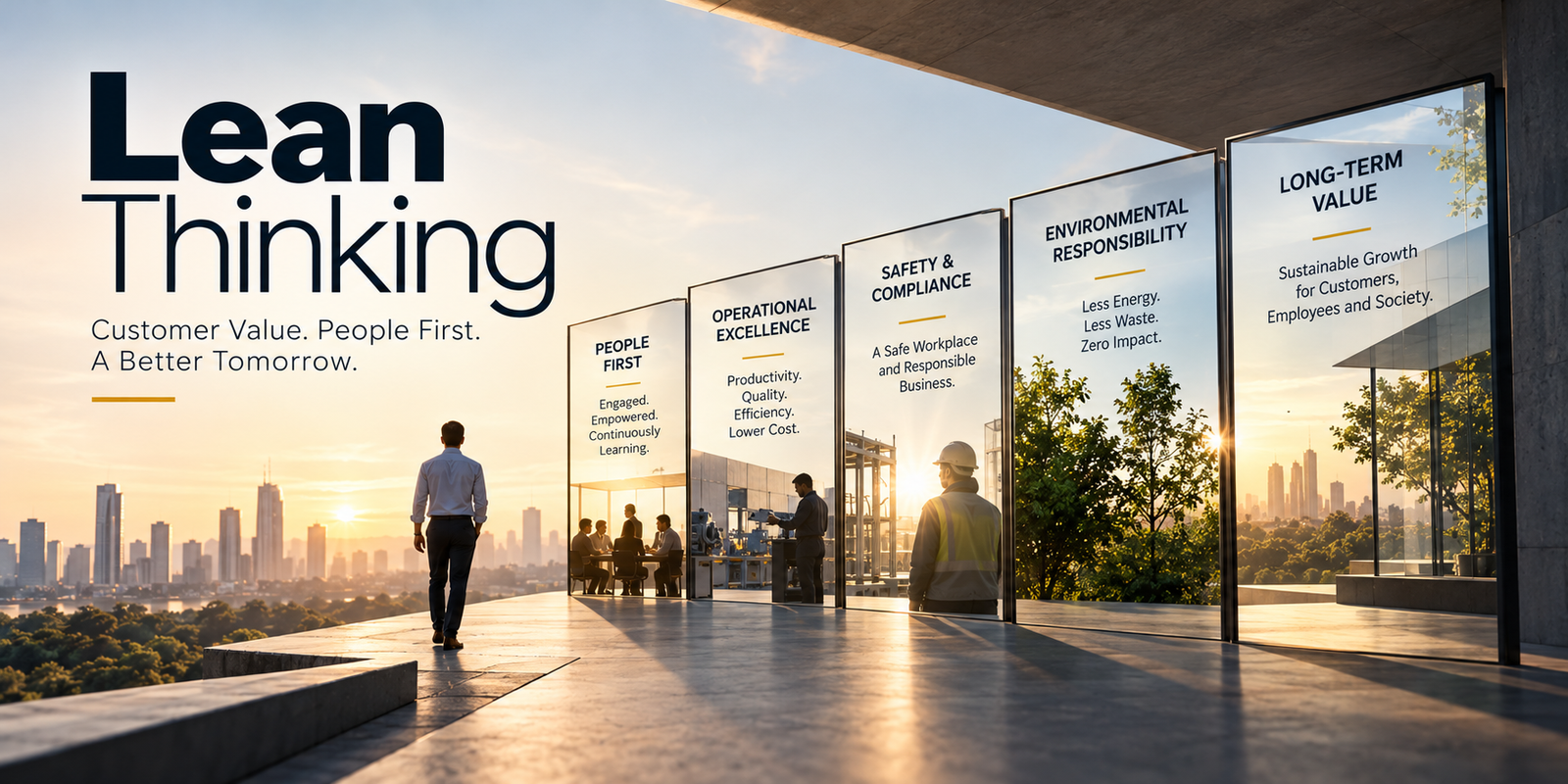
Lean Thinking: Customer Value, People First, A Better Tomorrow
Building a purpose-driven organisation through continuous improvement, mutual respect, and a relentless focus on customer value.
What Is Lean Thinking?
Lean Thinking is more than a collection of tools, techniques, or process-improvement methodologies. It is a management philosophy that shapes how an organisation defines value, designs its work, develops its people, and continuously improves the way it operates.
At its heart, Lean Thinking brings together two fundamental principles: creating maximum value for the customer and respecting the people who create that value.
It encourages organisations to question how work is performed, identify activities that do not contribute to value, eliminate unnecessary waste, and continuously improve the systems through which products and services are delivered.
However, Lean is not simply about doing more with fewer resources. Nor is it about asking employees to work harder, reducing headcount, or cutting costs in isolation.
True Lean Thinking is about designing better ways of working so that people can deliver better outcomes with less waste, greater consistency, and a stronger sense of purpose.
It is about building an organisation where improvement is not the responsibility of a separate department or an occasional transformation programme. Instead, it becomes part of everyday work.
Customer First: Defining Value from the Customer's Perspective
Every organisation exists to serve a customer, whether that customer is an individual consumer, another business, or an internal user of a service.
Yet organisations can sometimes become so focused on their internal activities, departmental targets, and established procedures that they lose sight of what the customer actually values.
Lean Thinking begins by reversing this perspective. Rather than asking, How can we improve our existing processes? it asks, What does the customer value, and how can we deliver it consistently?
For a customer purchasing a product or service, this typically means receiving:
The product or service requested, meeting agreed specifications and quality requirements.
Delivery at the promised time.
The right quantity, in accordance with the customer's requirements.
A price that reflects the value offered and that the customer is willing to pay.
These expectations appear straightforward, yet meeting them consistently requires coordination across the entire organisation.
Product design must reflect customer requirements. Procurement must ensure material availability. Production or service delivery must operate reliably. Quality systems must prevent defects. Logistics and support functions must fulfil their commitments.
A failure in any one of these areas can undermine the customer's experience, even when the other functions perform well.
Customer First Thinking therefore requires an end-to-end perspective. It is not enough for each department to perform its own activities efficiently; the entire system must work together to deliver the promised value.
It also requires organisations to listen continuously to customers, understand changing expectations, and adapt their products, services, and processes accordingly.
People First: Respect as the Foundation of Lean
If customer value defines the purpose of Lean, respect for people provides the foundation on which that purpose can be achieved.
Employees are not merely resources to be deployed in a production system. They are individuals with experience, judgement, creativity, and problem-solving capabilities that can improve the organisation in ways that management alone cannot achieve.
People performing the work often understand its difficulties better than anyone else. They see recurring problems, unnecessary movements, delays, quality issues, and opportunities for improvement every day.
The question is whether the organisation creates an environment in which this knowledge is heard, encouraged, and acted upon.
A People First approach involves:
Treating employees with dignity, listening to their concerns, and recognising their contributions.
Providing the training, coaching, and practical experience needed to strengthen technical knowledge and problem-solving skills.
Involving employees in identifying problems, testing solutions, and improving the work they perform.
Encouraging people to raise concerns, report mistakes, and experiment with improvements without fear of unfair blame.
Giving employees opportunities to learn, take ownership, and demonstrate their potential.
People First does not mean avoiding performance expectations or accountability. It means establishing high standards while providing the support, capability, and environment needed to achieve them.
An organisation that respects its people recognises that sustainable performance comes not from controlling every action, but from developing the capability of people to think, act, and improve.
Management of Support, Not Merely Management by Control
One of the most important shifts in Lean Thinking concerns the role of leadership.
In a traditional control-oriented environment, managers may spend much of their time monitoring performance, issuing instructions, escalating problems, and ensuring compliance with established procedures.
Standards and controls remain necessary, particularly where safety, quality, and regulatory compliance are concerned. However, control alone cannot create a continuously improving organisation.
A Lean leader asks a different set of questions:
“Are employees clear about the expected outcomes and standards?
“Do they have the skills, tools, information, and resources to perform their work?
“What obstacles are preventing them from succeeding?
“Are recurring problems being addressed at their root cause?
“How can management help teams improve their performance?
This is the essence of Management of Support.
Managers establish direction, clarify priorities, develop capability, remove obstacles, and create the conditions in which employees can solve problems effectively.
When a problem occurs, the emphasis shifts from immediately identifying who is responsible to understanding what happened, why it happened, and how recurrence can be prevented.
This does not remove accountability. It strengthens accountability by focusing on learning, corrective action, and systemic improvement.
The result is a workplace in which management and employees share responsibility for performance, rather than operating as separate groups with competing interests.
Lean Thinking Beyond Productivity and Cost Reduction
Lean Thinking is often associated with improving productivity, reducing waste, and lowering operating costs. These are important outcomes, but the philosophy extends much further.
Operational excellence
Lean encourages organisations to simplify workflows, improve process stability, reduce defects, eliminate unnecessary activities, and make better use of available resources.
The objective is to improve productivity, quality, efficiency, and effectiveness together.
Safety and regulatory compliance
No improvement should come at the expense of employee safety or compliance with applicable regulations.
Lean Thinking encourages organisations to identify hazards, improve workplace conditions, standardise safe practices, and integrate safety into the design of everyday work.
A process that delivers higher output but increases risk is not a successful improvement.
Environmental responsibility
excess material consumption, unnecessary transportation, avoidable energy use, rework, scrap, excess inventory, and inefficient resource utilisation.
By addressing these forms of waste, organisations can improve operational performance while reducing their environmental footprint.
The objective is not simply to lower costs, but to use resources more responsibly and reduce avoidable environmental impact.
Learning and problem-solving
Lean creates opportunities for employees to develop the ability to identify deviations, understand root causes, test countermeasures, and learn from results.
Over time, this builds an organisation that can respond more effectively to problems and adapt to changing conditions.
Long-term value creation
Lean Thinking encourages decisions that strengthen the organisation over time rather than maximise short-term results at the expense of future capability.
Investing in people, process reliability, quality, safety, customer relationships, and continuous improvement helps build a stronger foundation for sustainable growth.
Continuous Improvement: Making Better Work Part of Everyday Work
Continuous improvement, commonly associated with the Japanese concept of Kaizen, is a defining feature of Lean Thinking.
It recognises that even well-designed processes can be improved. Customer requirements evolve, technologies change, new risks emerge, and employees discover better ways of performing their work.
Continuous improvement creates a structured way to respond to these changes.
A team may identify recurring defects, investigate their causes, test a countermeasure, evaluate the results, and incorporate successful changes into standard work.
Another team may discover that a simple change in workplace layout reduces unnecessary movement and improves material flow.
In an office or shared-services environment, employees may redesign an approval process to eliminate duplicate checks and reduce waiting time without compromising necessary controls.
The scale of the improvement is less important than the discipline through which it is identified, tested, implemented, and sustained.
A culture of continuous improvement requires regular engagement between managers and employees, visible performance measures, structured problem-solving, and a willingness to learn from both success and failure.
It also requires leaders to respond constructively when employees identify problems. If issues are repeatedly raised but never addressed, participation and trust will gradually diminish.
The goal is to make improvement a normal part of work rather than an additional activity performed only when a special programme is launched.
What Does a High-Performing Lean Organisation Ultimately Achieve?
When customer value, respect for people, management support, operational excellence, and continuous improvement reinforce one another, Lean Thinking can produce benefits that extend across the organisation.
More reliable quality, shorter lead times, consistent delivery, appropriate pricing, and better service experiences.
Greater involvement, stronger problem-solving skills, safer working conditions, meaningful development opportunities, and a stronger sense of ownership.
Improved productivity, lower avoidable costs, greater process reliability, better resource utilisation, and stronger operational performance.
Reduced waste, more responsible resource consumption, improved energy efficiency, and lower environmental impact where the relevant improvements are achieved.
Greater resilience, stronger customer relationships, improved competitiveness, and a more capable workforce.
These outcomes are connected. Better employee capability can improve problem-solving. Better problem-solving can improve process stability. Greater process stability can improve quality and delivery. Better quality and delivery can strengthen customer trust and business performance.
The important point is that these benefits do not emerge from implementing Lean tools in isolation. They emerge when the underlying management philosophy, operating practices, and organisational behaviours work together.
Conclusion: Lean Is a Way of Thinking, Leading, and Working
Lean Thinking is ultimately about creating an organisation in which customer value provides direction, people are treated with respect, and continuous improvement becomes a shared responsibility.
It asks leaders to move beyond managing activities and begin developing capability. It encourages employees to move beyond following instructions and participate actively in improving their work. It challenges organisations to look beyond departmental performance and consider the value created across the entire system.
Most importantly, it recognises that operational excellence and human development are not competing priorities. They reinforce each other when the organisation is designed to support both.
The true measure of Lean maturity is therefore not the number of tools implemented, workshops conducted, or improvement projects completed. It is the extent to which the organisation consistently delivers customer value, develops its people, learns from problems, uses resources responsibly, and improves its performance over time.
Lean Thinking is not simply about eliminating waste. It is about creating the conditions in which people can do meaningful work, customers receive the value they expect, and the organisation becomes better every day.
That is how Lean moves from a set of improvement techniques to a way of leading and managing an organisation.
THE ESSENTIAL IDEA
Building a purpose-driven organisation through continuous improvement, mutual respect, and a relentless focus on customer value.
Progress becomes sustainable when purpose, people, processes and management systems reinforce one another.
REFERENCES
- Lean Thinking — James P. Womack and Daniel T. Jones
- Toyota Production System — Toyota
- Lean Enterprise Institute — Principles of Lean Thinking
- The Toyota Way — Jeffrey K. Liker
- ASQ — Continuous Improvement
Disclaimer: The views and opinions expressed in this article are personal and do not necessarily reflect those of any organisations associated with the author.