LEAN LEADERSHIP
How to Establish a Lean Thinking Mindset in Organizations
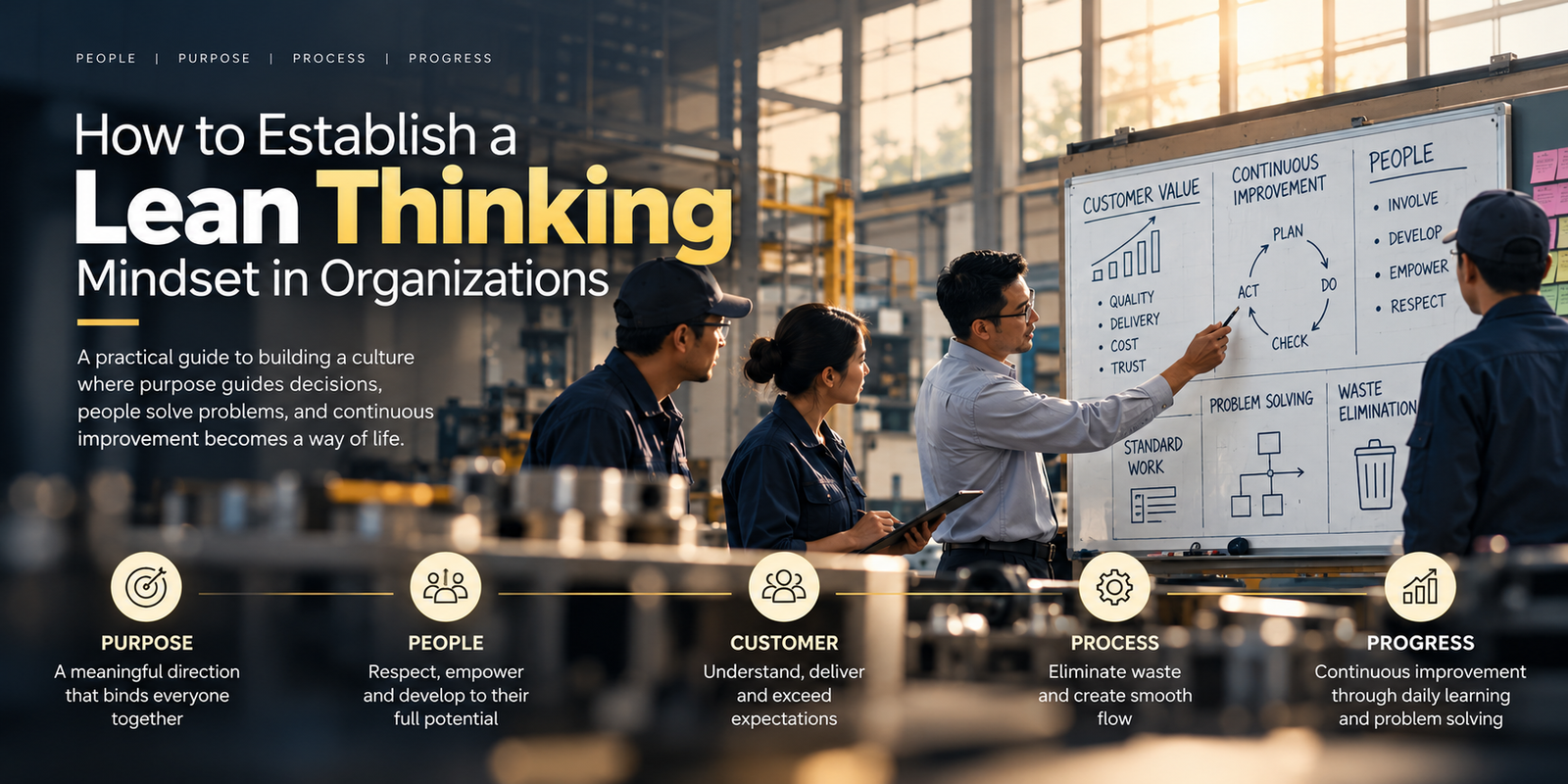
Building a culture where purpose guides decisions, people solve problems, and continuous improvement becomes part of everyday work.
Introduction: Lean Is a Way of Thinking, Not Just a Set of Tools
Many organizations embark on Lean transformation by introducing tools such as 5S, Kaizen, Value Stream Mapping, standard work, and mistake-proofing. These techniques can deliver significant improvements in productivity, quality, cost, and delivery. Yet, in many cases, the results are difficult to sustain once the initial improvement programme loses momentum.
“Why does this happen?
The answer often lies in the difference between implementing Lean tools and establishing a Lean Thinking mindset.
Lean Thinking is not merely a methodology for improving processes. It is a way of leading, managing, and organizing work so that the entire enterprise continuously creates value for its customers while developing the capabilities of its people.
Organizations with a strong Lean Thinking mindset are united by a meaningful purpose, a shared vision, and a set of values that influence how decisions are made and how work gets done.
These values typically include:
Employees, customers, suppliers, and the communities in which the organization operates.
The belief that individuals, teams, and processes can continuously improve through learning and practice.
Identifying problems, testing solutions, learning from results, and acting on opportunities rather than accepting the status quo.
Making daily improvement a habit, whether through incremental changes or more radical innovations.
The real objective is to create an organization where improvement does not depend on occasional initiatives or external consultants. Instead, it becomes an integral part of everyday management and work.
Lean as an Alternative Management System
The Toyota Production System (TPS) provides a powerful illustration of how Lean Thinking can be embedded into the way an organization operates.
TPS is widely recognized for combining continuous improvement, respect for people, standardized work, waste elimination, and built-in quality. Its effectiveness does not come from individual techniques operating independently, but from the way these principles reinforce one another within an integrated management system.
The system enables organizations to align their processes, governance, leadership practices, and employee capabilities around customer requirements.
Employees are not simply expected to follow instructions. They are developed and encouraged to understand the work they perform, recognize deviations from expected conditions, solve problems, and contribute to improving processes.
Problem-solving methods become part of the organization's everyday routines. Managers support employees in identifying obstacles, while teams use facts, standards, and structured experimentation to develop better ways of working.
Over time, these practices become habits. Existing employees reinforce them through their daily behaviour, while new employees learn by observing how colleagues identify problems, respond to abnormalities, and improve their work.
This is what distinguishes a Lean organization from one that has merely implemented a collection of improvement tools.
The ultimate objective is to make continuous improvement a natural way of working rather than a separate management initiative.
A Personal Observation from Japan: The Power of Daily Kaizen
During my work in Kashiwazaki, Japan, with a large automotive organization, I witnessed an example that reinforced my understanding of the Lean Thinking mindset.
The Japanese organization was a technology collaborator for our operations in India. While observing a manufacturing process, I noticed that the operating parameters and standard operating procedures used by the Japanese team differed from those followed for an apparently similar process on the same type of machine in India.
I asked the shift supervisor why their operating parameters differed from the specifications we had received.
His response was revealing. The team had been operating the process using the same standards approximately four months earlier. Since then, frontline workers had continuously improved the process through Kaizen, resulting in three revisions to the standard operating procedures.
What struck me was not simply the number of revisions. It was the speed and normality with which the organization incorporated improvements into its way of working.
The standard was not treated as a document that had to remain unchanged. It represented the best-known method at that point in time, subject to further improvement when evidence demonstrated a better way.
This observation highlighted an important distinction between organizations that encourage improvement and those that institutionalize it.
In a conventional environment, employees may identify a better method but wait for a special initiative, a management review, or a formal transformation programme before it is implemented.
In a Lean environment, employees are encouraged to improve the work continuously, with appropriate validation, approvals, and controls to ensure that changes maintain or improve quality and safety.
The process evolves as the organization learns.
Of course, different operating parameters should only be adopted after appropriate technical validation. The lesson is not that standards should change casually, but that they should evolve through disciplined improvement.
This experience reinforced a fundamental principle: standardization and continuous improvement are not contradictory. Standardization provides the foundation for improvement, while Kaizen enables the standard to evolve.
Establishing the Foundations of a Lean Thinking Mindset
Developing a Lean organization requires more than training employees in improvement tools. It requires a deliberate approach to purpose, strategy, leadership, customer value, employee participation, and the design of everyday work.
4.1 Purpose: Establishing a Meaningful Direction
Organizations with a strong Lean Thinking mindset understand why they exist beyond their immediate financial objectives.
A meaningful purpose provides direction, helps employees understand the significance of their contribution, and creates a shared basis for decision-making.
Toyota's corporate philosophy, for example, emphasizes contributing to society through its business activities and developing products and services that create value for customers.
The important lesson is not that every organization needs to adopt the same purpose. It is that leadership must articulate a credible direction that connects the organization's activities with a larger objective.
Employees should understand where the organization wants to go, why that destination matters, and how their everyday work contributes to reaching it.
A purpose statement that appears only in corporate presentations will have limited impact. Purpose becomes meaningful when it influences investment decisions, customer commitments, product development, resource allocation, and the way employees are treated.
4.2 Connecting Purpose, Strategy, and Execution
A meaningful purpose must translate into practical action.
Organizations need a clear line of sight between their long-term ambitions, strategic priorities, departmental objectives, team targets, and individual responsibilities.
This requires a structured approach to strategy deployment, sometimes associated with Hoshin Kanri in Lean management.
Leadership defines strategic priorities and identifies the critical factors that will determine success. These priorities are then translated into measurable objectives, coordinated improvement plans, and clear responsibilities across the organization.
For example, if the strategic objective is to improve customer delivery reliability, the corresponding priorities might include reducing production lead time, improving supplier performance, increasing process stability, and strengthening production planning.
Departments and teams must understand how their targets contribute to the overall objective and where collaboration is required.
Performance reviews, visual management, problem-solving routines, and appropriate recognition mechanisms help maintain alignment between strategy and execution.
The objective is not to create more KPIs. It is to ensure that the right measures and management routines guide the organization towards shared outcomes.
Defining Value from the Customer's Perspective
Lean Thinking begins with understanding what customers value.
Organizations must go beyond assumptions about customer needs and actively listen to feedback, study customer behaviour, understand changing expectations, and identify opportunities to improve the customer experience.
Value may involve product quality, reliability, delivery time, price, ease of use, technical support, or responsiveness.
These priorities differ across markets and customer segments. A customer purchasing a critical industrial component may value reliability and assured delivery more than a marginal price reduction. Another customer may place greater emphasis on customization or technical support.
A customer-centric organization makes these distinctions explicit and aligns its products, services, and operating processes accordingly.
Customer value must also guide internal decisions. Processes should be evaluated according to how effectively they contribute to customer outcomes, not merely by how efficiently individual departments complete their activities.
4.4 Delivering Customer Value Through Waste Elimination
Once customer value is understood, the organization must examine how that value is delivered.
Lean Thinking encourages organizations to identify activities that consume resources without contributing meaningfully to the required outcome.
These may include waiting, unnecessary transportation, excess inventory, avoidable movement, overproduction, defects, rework, and underutilized employee capabilities.
The objective is to improve the flow of value by simplifying processes, reducing unnecessary hand-offs, addressing bottlenecks, and improving process stability.
Waste elimination should not be confused with indiscriminate cost-cutting. Removing an activity that appears unnecessary without understanding its purpose can introduce quality problems, compliance risks, or additional work elsewhere.
Effective Lean improvement examines the complete process and removes waste while preserving or strengthening the activities essential to customer value, safety, and reliability.
4.5 Empowering Employees Through Daily Kaizen
A Lean organization recognizes that employees possess valuable knowledge about the processes they operate.
Frontline employees often identify problems long before these problems become visible in monthly performance reports. They understand where delays occur, which activities are unnecessarily difficult, and what conditions contribute to defects or disruptions.
Organizations must create mechanisms through which this knowledge can be converted into improvement.
These may include regular team meetings, Kaizen boards, structured improvement suggestions, problem-solving workshops, coaching, and clearly defined processes for testing and implementing ideas.
Employees need the authority and support to address problems within their responsibilities, while more complex or cross-functional issues should be escalated through an effective management system.
Leadership must also close the feedback loop. When employees contribute ideas, they should receive timely responses, understand the decisions made, and see how successful improvements are recognized and shared.
The goal is to develop an organization in which everyone, from the frontline to the executive team, understands how to identify problems, solve them systematically, and improve performance.
4.6 Discovering Better Ways of Working Through Visual Management
Visual management makes the condition of work and process performance easier to understand.
Well-designed workplaces use visual controls, clearly identified locations, standardized layouts, performance boards, and accessible information to help teams recognize normal conditions and identify abnormalities quickly.
The principles of 5S—Sort, Set in Order, Shine, Standardize, and Sustain—can help establish orderly, reliable, and efficient working environments.
However, visual management should not become a display of charts that employees update merely to satisfy reporting requirements.
Its purpose is to support decisions and action.
A useful visual management system helps teams understand whether work is progressing as expected, where performance is deviating from the standard, what requires attention, and who is responsible for resolving the issue.
When combined with regular management routines, visual management makes problems visible and encourages timely problem-solving.
4.7 Establishing Flow Across the Value Chain
Lean Thinking aims to create a smooth flow of work from the initial customer requirement to the final delivery of the product or service.
In practice, work often becomes fragmented by functional boundaries, excessive approvals, large batches, scheduling conflicts, and delays in information or material availability.
Establishing flow requires organizations to examine the entire value stream rather than optimizing individual activities in isolation.
This may involve reducing batch sizes, improving production scheduling, simplifying approvals, balancing workloads, strengthening supplier coordination, or redesigning information flows.
The desired outcome is not simply faster individual operations. It is shorter end-to-end lead time, greater transparency, fewer interruptions, and more reliable delivery to customers.
Flow also reveals constraints that might otherwise remain hidden. A highly productive department cannot improve overall delivery if another part of the system remains a bottleneck.
4.8 Preventing Errors and Learning from Problems
A strong Lean organization does not treat recurring defects as an unavoidable cost of doing business.
It investigates the conditions that allow problems to occur and develops countermeasures that reduce the likelihood of recurrence.
Techniques such as root-cause analysis, the Five Whys, cause-and-effect analysis, mistake-proofing (Poka-Yoke), and statistical process control can help teams understand and address the sources of process variation and failure.
Where appropriate, processes should be designed to prevent mistakes or detect them immediately rather than relying solely on final inspection.
Equally important is the way management responds when problems occur.
Employees should be encouraged to surface issues early, rather than conceal them to protect performance numbers. At the same time, corrective actions must be implemented and verified to ensure that the underlying problem has been addressed.
A learning organization distinguishes between honest mistakes, weaknesses in process design, and deliberate disregard for established standards. This enables it to maintain accountability while encouraging transparency and continuous improvement.
4.9 Standardization: Creating a Foundation for Continuous Improvement
Standardization is essential to sustaining Lean Thinking.
When work is performed differently by different people without a clear reason, performance becomes difficult to predict, problems become harder to diagnose, and successful improvements are difficult to replicate.
Standard work establishes the best-known method for performing a task under defined conditions. It provides a baseline against which deviations can be identified and improvements evaluated.
Standards should be clear, practical, accessible, and understood by the people who use them.
When a better method is demonstrated, the standard should be reviewed and updated through the appropriate process. Employees should then be trained in the revised method, and its effectiveness should be monitored.
establish the standard, perform the work, identify deviations, investigate problems, improve the process, and update the standard.
Standardization is therefore not about rigidly preserving the status quo. It is about ensuring that improvements become part of everyday practice until a better method is established.
The Role of Leadership: Making Lean a Way of Life
Even well-designed improvement systems will struggle if leadership behaviour contradicts Lean principles.
Leaders must demonstrate the values they expect employees to adopt. They need to spend time understanding work where it happens, ask questions rather than jump immediately to conclusions, support structured problem-solving, and ensure that employees have the capabilities and resources required to improve.
This includes establishing a management system that balances performance accountability with coaching and development.
Leaders should also recognize that Lean transformation is not a short-term campaign. It requires sustained commitment, consistent routines, and a willingness to challenge established practices—including those that have historically contributed to success.
The transition may involve changing performance measures, decision-making processes, organizational responsibilities, and long-standing management habits.
Progress should therefore be assessed not only through productivity or cost improvements but also through the organization's growing ability to identify problems, develop people, and sustain better ways of working.
What Does a Lean Thinking Mindset Ultimately Deliver?
When these principles reinforce one another, organizations can build a virtuous cycle of improvement.
Employees become more capable of identifying and solving problems. Processes become more stable and reliable. Waste and unnecessary complexity decline. Customer requirements are met more consistently, while management gains greater visibility into operational performance.
The potential business outcomes include:
Better customer experience, satisfaction, and loyalty.
Improved quality, productivity, and delivery reliability.
Lower avoidable costs, waste, and rework.
Greater employee involvement and problem-solving capability.
Improved responsiveness to changing market requirements.
More effective use of resources and stronger environmental performance.
Sustainable growth, profitability, and competitiveness.
These outcomes are not automatic. They depend on the quality of implementation, the organization's operating context, and its ability to sustain the underlying practices over time.
The defining characteristic of a Lean organization is its ability to keep learning and improving rather than relying on a series of isolated successes.
Conclusion: Building an Organization That Improves Every Day
Establishing a Lean Thinking mindset is fundamentally about creating the conditions in which people can deliver value, solve problems, and continuously improve the work they perform.
Purpose provides direction. Strategy connects ambition with execution. Customer-centricity defines value. Employee empowerment creates the capacity to improve. Visual management, flow, mistake-proofing, and standardization provide the disciplines through which improvement becomes sustainable.
My experience in Kashiwazaki reinforced a powerful lesson: the strength of a Lean organization is revealed not merely by the processes it has established, but by how naturally and consistently its people improve those processes.
The goal is not to create an organization that occasionally conducts Kaizen events. It is to develop an organization in which improvement is an everyday responsibility, supported by leadership, enabled by capability, and guided by customer value.
Lean Thinking becomes a true organizational mindset when every employee understands the purpose, every leader supports improvement, and every process remains open to becoming better.
THE ESSENTIAL IDEA
Building a culture where purpose guides decisions, people solve problems, and continuous improvement becomes part of everyday work.
Progress becomes sustainable when purpose, people, processes and management systems reinforce one another.
REFERENCES
- Toyota Production System — Toyota
- Lean Thinking — James P. Womack and Daniel T. Jones
- Lean Enterprise Institute — Explore Lean
- Toyota Way — Jeffrey K. Liker
- ASQ — Continuous Improvement
Disclaimer: The views and opinions expressed in this article are personal and do not necessarily reflect those of any organisations associated with the author.