
GCC LEADERSHIP
GCCs Reimagined Part II: A Leadership Narrative on Enabling GCC Maturity
How leaders enable the journey from earned credibility and local reinvention to enterprise-wide intelligence and strategic influence.
From Reframing to Enablement
In the earlier paper, GCCs Reimagined — From Extended Enterprise to Intelligence Conduits, the focus was deliberately on reframing the role of Global Capability Centres. The argument was simple but unsettling: GCCs can no longer be understood merely as scaled execution engines.
In an environment shaped by volatility, digital acceleration, and interconnected risk, enterprises require systems that can think, learn, and adapt — not just deliver.
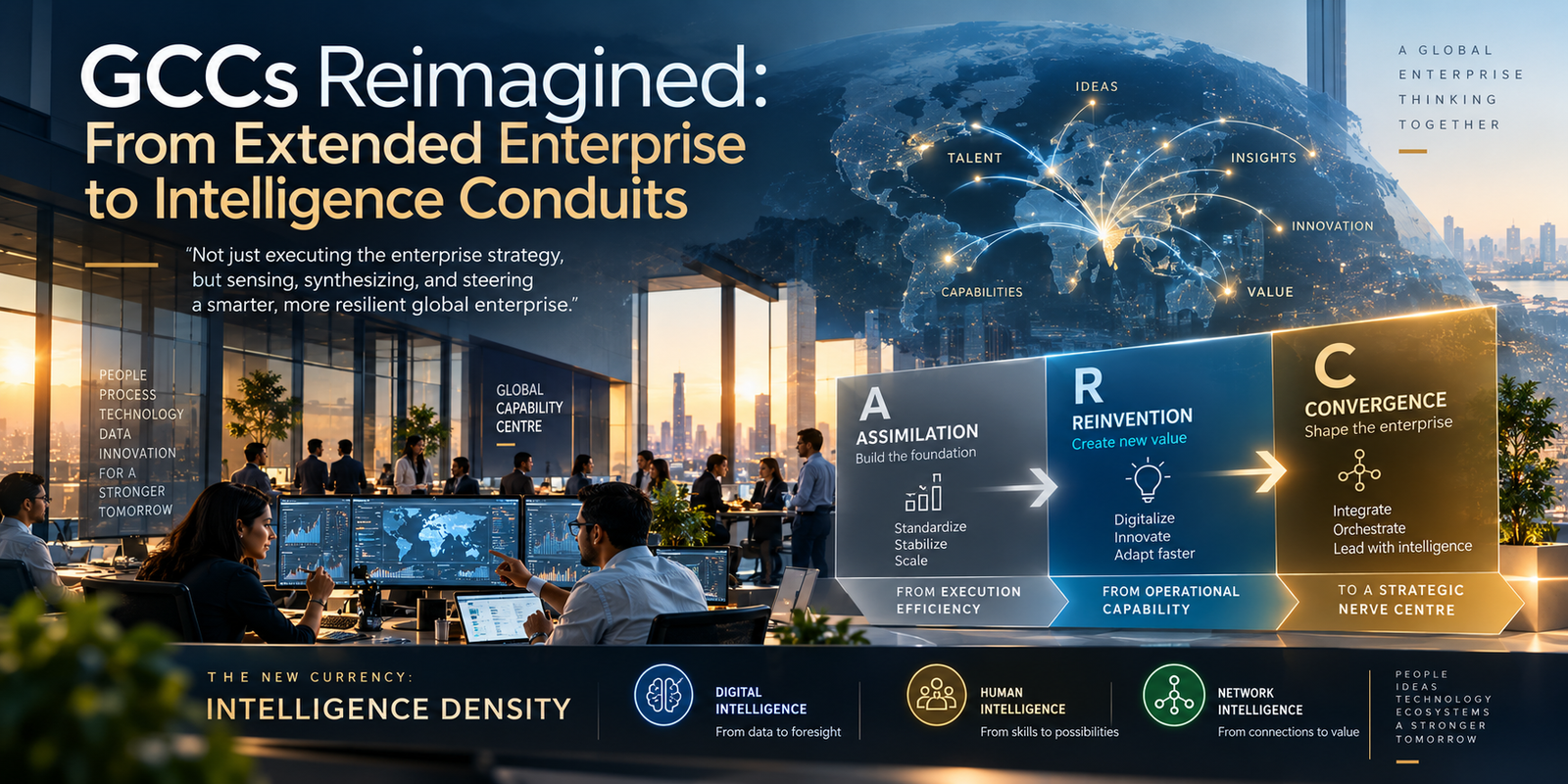
That paper introduced the idea of GCCs as intelligence conduits and outlined the ARC maturity lens — Assimilation, Reinvention, and Convergence — as a way to understand this evolution.
What it did not do, by design, was explain how leaders actually enable that evolution, or how they know when a GCC is truly ready to move forward rather than merely aspiring to do so.
This paper enters that space. What follows is not a framework restated, but a leadership narrative — a close-to-the-ground view of how maturity unfolds inside GCCs, how it feels when progress is real, and how leaders recognise the difference between readiness and rhetoric.
Where the Journey Really Begins
Every GCC transformation begins in a familiar place: confidence mixed with constraint. The centre is delivering, often at scale. Metrics look healthy. SLAs are met. Yet conversations with the enterprise feel narrow, transactional, and tightly controlled. Requests arrive fully formed. Feedback flows one way. Decisions are taken elsewhere.
At this point, many leaders feel the pull to leap ahead — to introduce innovation programmes, advanced analytics, or new operating models. But experienced GCC leaders know that influence cannot be declared; it must be earned.
Maturity begins not with ambition, but with credibility.
This is the space of Assimilation — not as a phase on a slide, but as a lived condition. Work is stable. Processes behave predictably. Variance is understood rather than explained away. Compliance no longer dominates conversation because it has become habitual. Digital tools reflect reality rather than decorate it.
Something subtle happens when this state is reached. Enterprise stakeholders stop checking. They start asking. The tone shifts from ‘Are you following the process?’ to ‘What are you seeing?’
That shift is the first real signal of readiness.
When Improvement Stops Being Reactive
As confidence stabilises, a second tension emerges. Teams no longer struggle to deliver, but they begin to notice inefficiencies that sit outside their immediate scope. Data surfaces patterns that raise questions about upstream decisions, handoffs, and legacy assumptions.
This is where Reinvention begins — not with an announcement, but with curiosity.
The work itself starts to change character. Conversations move from throughput to learning. Teams compare outcomes across contexts. Agile practices appear, not as ceremonies, but as ways to shorten feedback loops. Lean evolves from control into a discipline of reflection.
Importantly, Reinvention does not feel like disruption when it is ready. It feels like relief. Problems that were previously endured can now be discussed. Evidence replaces opinion. Experiments are framed carefully, not recklessly.
GCC leaders know Reinvention is real when insights travel without being filtered, when teams explain why something changed rather than what changed, and when improvement ideas begin to originate locally rather than arriving as mandates.
What once felt like execution now starts to feel like contribution.
The Moment Influence Begins to Shift
There is a point — often unannounced — when the GCC’s role in the enterprise subtly changes. Strategy discussions reference data generated by the centre. Early signals detected in operations influence planning assumptions. External perspectives — startups, academia, and partners — enter the conversation through GCC-enabled channels.
This is Convergence, and it is less dramatic than expected.
No new organisation chart appears. No authority is formally transferred. Yet decisions begin to carry the imprint of insights that originated in the GCC. Intelligence flows upstream as naturally as work once flowed downstream.
At this stage, the GCC behaves less like a centre and more like a synapse — connecting sensing, interpretation, and action across the enterprise. Leadership attention shifts again, this time from enabling capability to sustaining coherence.
Governance evolves to support integration rather than control. Technology, talent, and partnerships begin to act as a system rather than as independent investments.
Convergence is unmistakable when the enterprise stops asking how the GCC can support strategy — and starts expecting it to shape strategy.
How Leaders Know Maturity Is Real
Across this journey, experienced GCC leaders stop relying on traditional signals such as size, cost, or utilisation to judge progress. These remain necessary, but they no longer tell the whole story.
Instead, attention turns to intelligence density — how much of the work produces insight, foresight, or learning that changes decisions elsewhere.
Maturity becomes visible when decision cycles shorten without escalation, when insights are reused across contexts, and when the organisation responds earlier rather than faster. Intelligence density reveals whether transformation has altered how the enterprise thinks, not just how it operates.
This is also where many digital transformations reveal their limits. Automation without learning increases speed but not sense-making. Data without process understanding creates noise.
That is why DigiLean emerges as an enabler rather than an initiative. By grounding digital capability in process reality and embedding learning into daily work, DigiLean allows intelligence to scale without destabilising the system.
The Real Journey from Execution to Intelligence
The most mature GCCs do not proclaim transformation; they become integral to the enterprise’s functioning. They no longer wait for work to arrive fully defined. They help define it. They no longer optimise in isolation. They integrate. They no longer measure success only in efficiency terms. They measure it in how well the enterprise anticipates change.
In this state, the GCC is no longer an extended enterprise. It is part of the enterprise’s thinking apparatus — continuously sensing, learning, and shaping what comes next.
That is the real journey from execution to intelligence. It unfolds not through steps, but through disciplined leadership, earned trust, and the deliberate sequencing of maturity.
THE ESSENTIAL IDEA
How leaders enable the journey from earned credibility and local reinvention to enterprise-wide intelligence and strategic influence.
Progress becomes sustainable when purpose, people, processes and management systems reinforce one another.
REFERENCES
- GCCs Reimagined: From Extended Enterprise to Intelligence Conduits — Part I
Disclaimer: The views and opinions expressed in this article are personal and do not necessarily reflect those of any organisations associated with the author.