
GCC STRATEGY
GCCs Reimagined: From Extended Enterprise to Intelligence Conduits
How Global Capability Centres can evolve from execution engines into intelligence conduits that sense, synthesize, and steer the global enterprise.
The Shifting Paradigm: From Execution to Orchestration
The story of Global Capability Centres has largely been told through the lens of cost, capability, and consolidation. Yet, as global enterprises rewire themselves for resilience and growth in a volatile world, the traditional narrative no longer holds.
The real question today is not why GCCs exist — it is what they are evolving into.
India, as the gravitational centre of this evolution, offers a useful lens for decoding what the next generation of GCCs might look like — not as extensions of the parent, but as intelligence conduits that sense, synthesize, and steer the global enterprise.
Most GCCs were born as execution engines, designed to scale operational efficiency through talent, cost arbitrage, and process replication. But technological, geopolitical, and cultural disruption has pushed these centres to become orchestrators of value, not just executors of tasks.
What used to be a centre of excellence is now turning into a Centre of Convergence, where diverse capabilities — from AI to behavioural analytics — intersect to reshape enterprise performance.
From transactional work to transformation work
From siloed domains to cross-functional ecosystems
From delivery metrics to design metrics — measuring how GCCs shape customer, employee, and innovation outcomes.
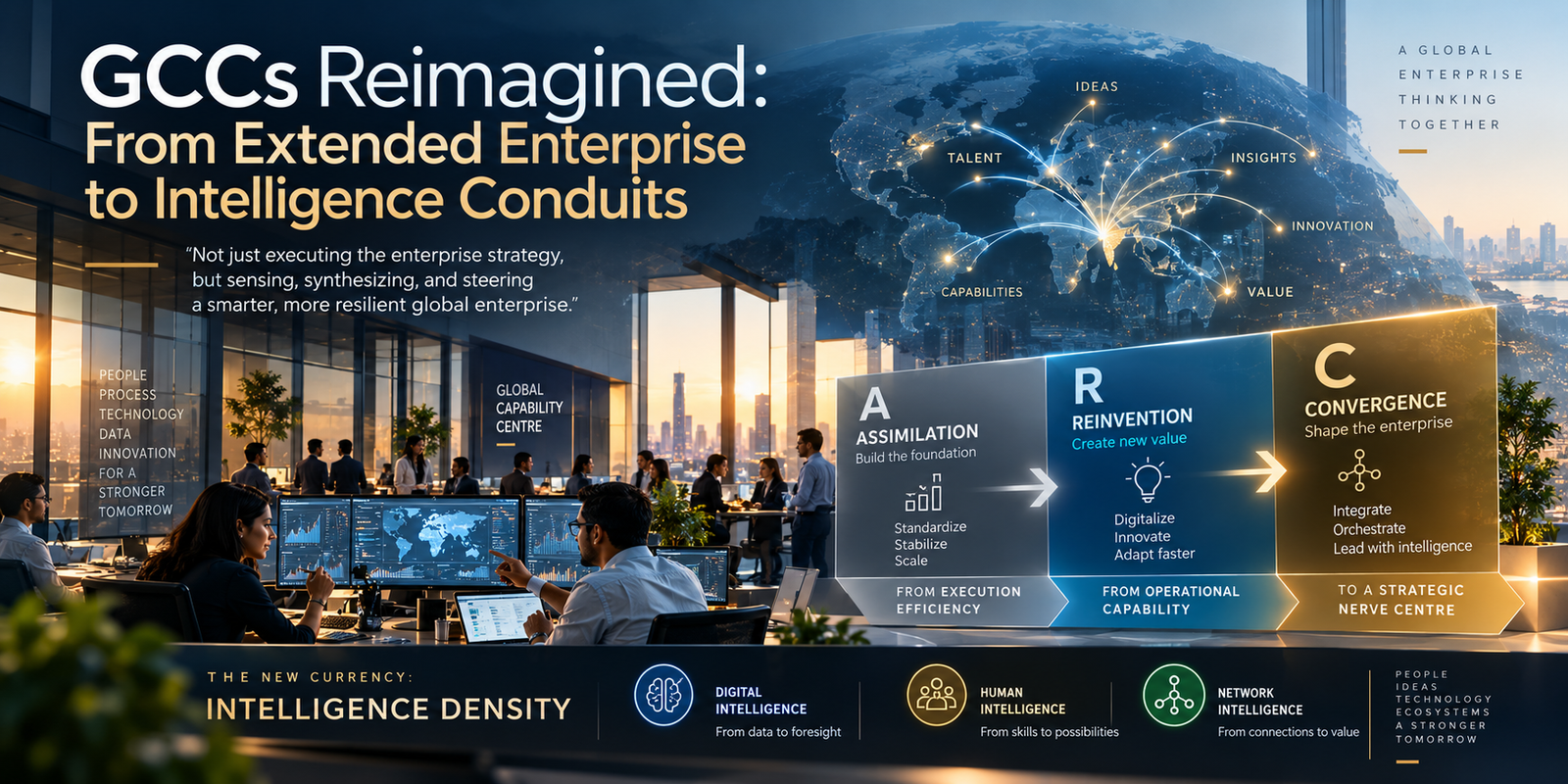
Introducing the ARC Model: The Three Horizons of GCC Maturity
The ARC Model offers a new lens for assessing GCC maturity. It moves beyond cost or capability metrics to capture cognitive, cultural, and connective value.
The focus is establishing and aligning the GCC with enterprise goals. The central question is, ‘How do we replicate what works efficiently?’ Illustrative capabilities include Lean Management, process excellence, LCA, digitalisation, and compliance rigour.
The focus shifts to redesigning value creation around innovation and agility. The question becomes, ‘How do we adapt and improve faster than the enterprise itself?’ Capabilities include agile delivery, digital transformation, and data-driven decision-making.
Technology, talent, and ecosystem partners become an intelligent network. The defining question is, ‘How do we shape enterprise strategy through insight and foresight?’ Capabilities include AI-augmented operations, ecosystem orchestration, and innovation incubation.
At the Assimilation stage, the GCC mirrors the parent.
In Reinvention, it begins to challenge the parent.
At Convergence, it leads the parent — transforming from execution arm to strategic nerve centre.
The New Currency: Intelligence Density
The maturity of a GCC is no longer measured by headcount or cost efficiency, but by its intelligence density — the proportion of its activities that create new insight, foresight, or innovation.
The ability to translate data into foresight through AI, automation, and analytics.
The ability to blend domain depth with curiosity, empathy, design thinking, and systems thinking.
The ability to co-create value across partners, academia, startups, and regulators.
The most mature GCCs are not simply doing digital; they are designing digital intelligence into every workflow, governance process, and decision model.
As a Lean practitioner with experience integrating Lean principles with digital transformation, I believe DigiLean is the frontier. It provides the connective tissue between operational excellence and digital intelligence — ensuring that technology adoption does not automate inefficiency, but eliminates waste, enhances flow, and amplifies learning.
DigiLean transforms GCCs from digital implementers into systemic innovators — organisations capable of sensing value, simplifying complexity, and scaling intelligence across every layer of the enterprise.
Beyond Silos: The Rise of Enterprise Synapses
In many ways, next-generation GCCs function like neural synapses of the enterprise — transmitting signals, context, and learning across geographies.
Their power lies not in scale, but in connectivity: the ability to shorten the cycle between sensing what is happening in the market, interpreting what it means for the business, and acting on how to respond.
This capability redefines traditional HQ–GCC dynamics. The future GCC will not wait for strategy to cascade — it will help construct it.
From Value Chain to Value Fabric
The linear notion of value chain support is dissolving into a value fabric, where the GCC weaves together threads of technology, culture, and innovation.
Technology enables visibility and velocity.
Culture sustains curiosity and collaboration.
Governance ensures coherence across borders.
Those who master this integration will move beyond being support hubs to becoming strategic amplifiers — shaping both economic and cognitive returns for their parent organisations.
A Call to Leadership: Redefining the Mandate
The GCC narrative needs a new leadership vocabulary. Leaders must stop asking, ‘What processes can we migrate?’ and begin asking, ‘What futures can we design from here?’
Reimagining talent architecture — from specialists to systemic polymaths.
Creating learning ecosystems that enable perpetual skill evolution.
Embedding ESG, risk intelligence, and compliance not as tick-boxes but as strategic differentiators.
The GCC of tomorrow is not a mirror of the enterprise; it is its digital twin of intelligence — continuously learning, adapting, and expanding the boundaries of what is possible.
From Scale to Sophistication
India’s GCC ecosystem stands at a rare inflection point — abundant talent, maturing infrastructure, and an evolving policy environment. But the true differentiator will be the shift from scale to sophistication.
The next decade will belong to those GCCs that can convert operational excellence into organisational intelligence — becoming the thinking, sensing, and designing extensions of the global enterprise.
In that transformation lies not just efficiency, but evolution.
THE ESSENTIAL IDEA
How Global Capability Centres can evolve from execution engines into intelligence conduits that sense, synthesize, and steer the global enterprise.
Progress becomes sustainable when purpose, people, processes and management systems reinforce one another.
Disclaimer: The views and opinions expressed in this article are personal and do not necessarily reflect those of any organisations associated with the author.