QUALITY 4.0
Evolution of Quality 4.0: From Inspection to Intelligent Quality Management
How quality has evolved from detecting defects to designing intelligent, connected, and continuously improving systems.
Introduction: Quality Is No Longer Just About Detecting Defects
Quality management has evolved significantly alongside industrial development. What began as an activity focused on inspecting finished products has gradually developed into a business-wide discipline encompassing process control, customer satisfaction, continuous improvement, and intelligent, data-driven decision-making.
Today, the emergence of Industry 4.0 technologies—including the Internet of Things (IoT), artificial intelligence (AI), machine learning, advanced analytics, and connected manufacturing systems—is transforming how organisations understand and manage quality.
This evolution is commonly described through the concept of Quality 4.0.
Quality 4.0 is not simply the application of digital technologies to existing quality processes. It represents an opportunity to rethink how quality is designed, monitored, managed, and continuously improved across the enterprise.
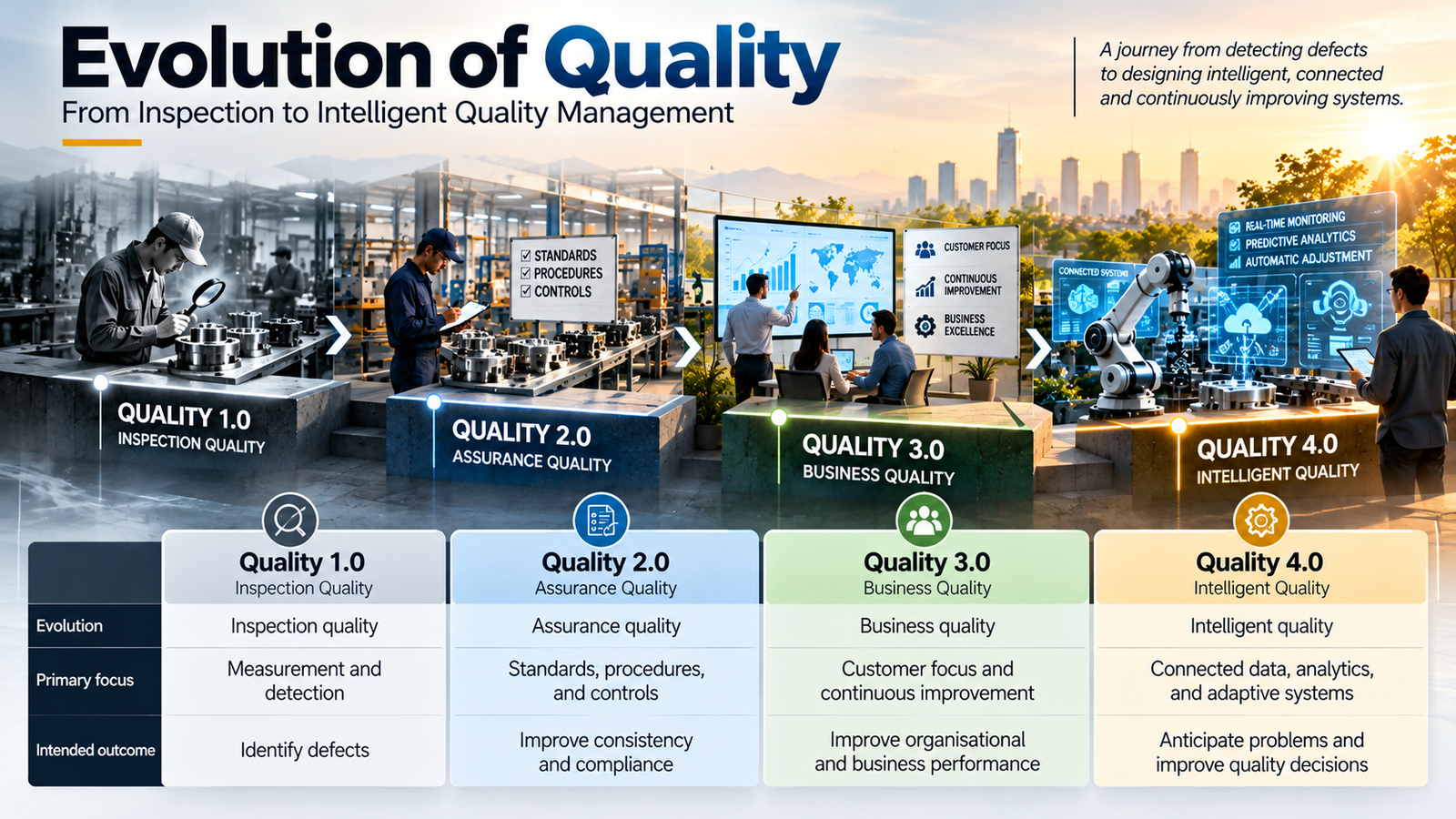
To appreciate this transformation, it is useful to examine the progression from Quality 1.0 through Quality 4.0.
Quality 1.0: Inspection Quality
The earliest phase of industrial quality management was predominantly centred on inspection and measurement. The primary objective was to identify defective products and separate them from those that met the required specifications.
As industrial production expanded, particularly with the development of mass manufacturing, inspection became an important mechanism for maintaining consistency in output.
However, this approach had a fundamental limitation: inspection detects defects, but it does not necessarily prevent them from occurring.
Quality problems were often identified after production had taken place, when the costs of scrap, rework, and replacement had already been incurred.
The emphasis frequently remained on achieving production volumes, with quality acting as a checkpoint rather than an integral part of the production system. The underlying causes of defects, process variation, and waste did not always receive sufficient attention.
In many environments, workers were expected to meet production targets, while inspection personnel were responsible for identifying quality failures.
This separation created a reactive approach to quality management.
The lessons from this phase remain relevant today. Even with sophisticated inspection equipment, an organisation cannot rely on inspection alone to guarantee consistent quality. The objective must eventually shift towards designing processes that produce the required results reliably.
Quality 2.0: Assurance Quality
As industrial systems matured, organisations began moving beyond inspection towards more structured quality assurance practices.
Quality 2.0 can be understood as a phase in which documented procedures, defined standards, statistical techniques, and systematic checks became increasingly important.
The objective was to establish greater consistency and ensure that products and processes met specified requirements.
Organisations increasingly used measures such as defect rates, scrap, rework, and labour productivity to evaluate operational performance. Standard operating procedures and inspection plans helped establish a more disciplined approach to production.
This represented meaningful progress over purely reactive inspection.
Nevertheless, quality assurance could still become a compliance-oriented activity if the organisation focused primarily on meeting minimum requirements rather than continually improving the entire system.
A process might consistently meet its defined specifications yet remain unnecessarily expensive, slow, wasteful, or difficult for employees to operate.
Similarly, measuring productivity through output per worker alone could encourage local optimisation without adequately considering safety, quality, customer value, or overall process performance.
The next stage of evolution required a broader perspective—one in which quality was connected directly to business performance and customer expectations.
Quality 3.0: Business Quality
Quality 3.0 represents a shift towards treating quality as an organisation-wide business responsibility rather than a function confined to inspection or quality assurance.
In this phase, meeting customer requirements becomes central to how products, services, and processes are designed and managed.
Quality is increasingly integrated with operational excellence, leadership, employee involvement, standardisation, and continuous improvement.
Several developments helped strengthen this perspective.
Organisations began placing greater emphasis on understanding customer expectations and translating them into product and service requirements.
Statistical process control and structured problem-solving helped organisations understand variation and improve process consistency.
Quality management systems, including ISO 9001, provided frameworks for establishing consistent processes, responsibilities, and continual improvement practices.
Workers became increasingly involved in identifying problems, improving work methods, and preventing recurring defects.
Organisations began assessing performance across multiple dimensions, including leadership, strategy, customer satisfaction, workforce development, and operational results.
This broader perspective recognised that quality is produced by the system as a whole. Product design, supplier performance, employee capability, equipment reliability, process discipline, and management decisions all influence the final outcome.
The emphasis consequently moved from simply checking whether a product was acceptable to building an organisation capable of delivering customer value consistently.
However, traditional quality management systems may still rely heavily on periodic audits, retrospective reporting, manual analysis, and human intervention to identify emerging problems.
As industrial systems become increasingly connected and complex, new opportunities arise to detect deviations earlier, anticipate failures, and adjust processes using real-time information.
This creates the foundation for Quality 4.0.
Quality 4.0: Intelligent and Connected Quality
Quality 4.0 builds on established quality management principles by integrating digital technologies, connected systems, advanced analytics, and intelligent decision-making.
Its purpose is not to replace quality fundamentals but to strengthen them through better information, faster feedback, improved traceability, and more responsive processes.
In a Quality 4.0 environment, data can be collected from machines, sensors, production systems, inspection equipment, suppliers, and customer interactions. When this information is connected and analysed effectively, organisations can gain a more comprehensive understanding of quality performance.
Consider a manufacturing line producing precision components.
In a conventional environment, a quality problem might be identified during final inspection, after several batches have already been produced.
In a more connected environment, sensors and process-monitoring systems can identify unusual operating conditions as they emerge. Analytics can help determine whether these deviations are associated with changes in temperature, vibration, machine settings, material properties, or other process parameters.
Operators and engineers can investigate the issue earlier, take corrective action, and reduce the likelihood of producing additional defective components.
With sufficiently reliable data and validated models, predictive analytics may also help identify conditions associated with future failures.
In selected applications, closed-loop control systems can automatically adjust process parameters within defined operating limits. Such capabilities require appropriate validation, safety controls, and human oversight.
The shift is therefore from a predominantly retrospective approach towards more connected, predictive, and potentially adaptive quality management.
Key dimensions of Quality 4.0
Connected equipment and digital systems provide more timely information about process conditions and quality performance.
Statistical models and machine learning can help identify patterns associated with defects, equipment deterioration, or process instability.
Connected records can link materials, suppliers, process parameters, inspections, and finished products, supporting faster investigations and more effective root-cause analysis.
Analytics can help engineers and managers prioritise quality issues, evaluate potential causes, and make better-informed decisions.
Validated control systems can respond to detected deviations, helping maintain process conditions within specified limits.
Quality information can be connected across design, procurement, manufacturing, logistics, and customer service, enabling organisations to investigate issues beyond the boundaries of individual departments.
Importantly, Quality 4.0 does not mean that every process should become autonomous. The appropriate level of automation depends on process risk, data quality, technical feasibility, and the consequences of an incorrect decision.
Human expertise remains essential for interpreting context, challenging assumptions, validating models, and deciding how the organisation should respond.
Understanding the Evolution at a Glance
These phases are a useful conceptual framework for understanding the evolution of quality management. They should not be interpreted as rigid historical periods in which one approach completely replaced another. Inspection, standardisation, process improvement, and digital intelligence continue to coexist in modern organisations.
The important distinction lies in the increasing ability to prevent defects, connect quality with business outcomes, and use information to make the entire system more responsive.
Quality 4.0 Requires More Than Technology
A common misconception is that implementing sensors, analytics platforms, or artificial intelligence automatically creates a Quality 4.0 organisation.
In reality, digital technologies can only deliver sustainable value when supported by sound processes, reliable data, capable people, and effective management practices.
Consider an organisation that installs advanced monitoring systems across its manufacturing operations. If process standards are unclear, measurement systems are unreliable, and employees lack the skills to interpret alerts, the organisation may generate more data without improving quality.
Similarly, an algorithm cannot compensate reliably for poorly defined quality requirements or an unstable manufacturing process.
Successful Quality 4.0 initiatives therefore require attention to several foundational elements:
Establishing clear standards, stable processes, and effective problem-solving methods.
Ensuring that data are accurate, consistent, timely, and suitable for the decisions they are intended to support.
Developing the skills required to work with connected systems, analytics, and new quality-management methods.
Connecting relevant information across operational and business systems.
Establishing appropriate controls, cybersecurity measures, model validation, and accountability.
Using digital insights to improve processes rather than simply automate existing ways of working.
The most effective approach is to combine the strengths of traditional quality management with the capabilities offered by digital technologies.
Conclusion: From Quality Control to Quality by Design
The evolution of quality management reflects a fundamental change in how organisations understand and create quality.
Quality 1.0 emphasised the detection of defects. Quality 2.0 strengthened assurance through standards and structured controls. Quality 3.0 connected quality with customer requirements, continuous improvement, and business performance. Quality 4.0 extends these foundations through connected systems, data-driven insights, predictive capabilities, and adaptive process management.
delivering products and services that consistently meet customer requirements.
What changes is the organisation's ability to achieve this purpose—with greater visibility, stronger prevention, faster feedback, and more informed decisions.
The future of quality will not be determined by technology alone. It will depend on how effectively organisations combine process excellence, human capability, sound management systems, and digital intelligence.
The ultimate ambition of Quality 4.0 is not simply to inspect quality faster or detect defects earlier. It is to design and manage systems that make quality more predictable, preventable, and integral to business performance.
THE ESSENTIAL IDEA
How quality has evolved from detecting defects to designing intelligent, connected, and continuously improving systems.
Progress becomes sustainable when purpose, people, processes and management systems reinforce one another.
Disclaimer: The views and opinions expressed in this article are personal and do not necessarily reflect those of any organisations associated with the author.